

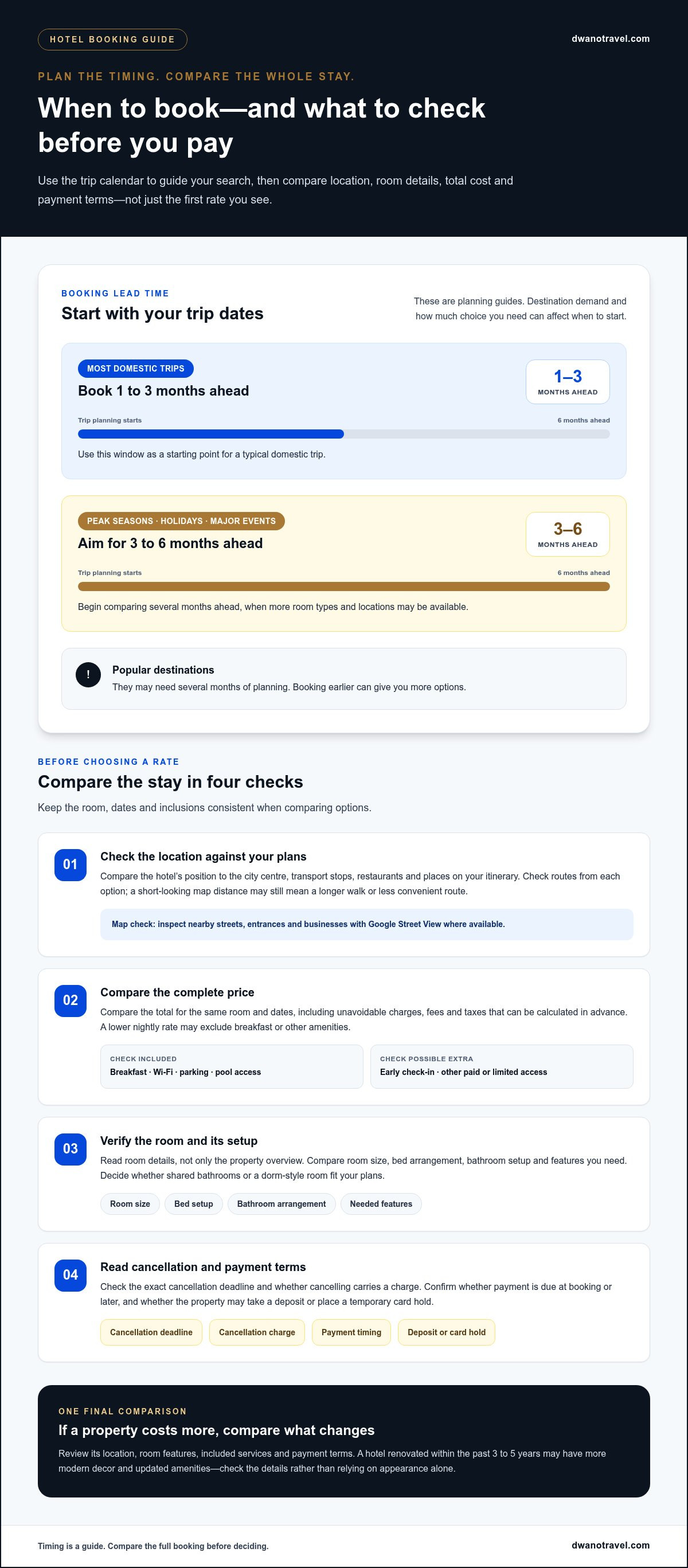
Choose a hotel booking by matching the timing, location, price, and policies to your trip. For most domestic trips, book 1 to 3 months ahead; peak seasons, holidays, major events, and popular destinations may call for 3 to 6 months. Booking early gives you more choice, but the best booking site is only one part of the decision.
Compare the whole stay—not just the headline rate. Location, total cost, amenities, cancellation terms, and timing all shape whether a booking truly suits your plans.
This guide walks you through comparing hotels and booking sites, choosing useful amenities, checking policies, and timing your reservation. Use the steps to narrow your options and spend less time searching.
Key Takeaways
- Filter by your priorities, then compare the total cost, included amenities, and cancellation terms.
- Use maps and street-level views to check the surroundings, routes, and transport links.
- Choose a location for your daily travel—not simply its distance from the city centre.
- Read cancellation deadlines and payment details before you book.
- Book most domestic trips 1 to 3 months ahead, or 3 to 6 months ahead for peak periods and major events.
What amenities should you look for in a hotel?
Start with the essentials: total price, cancellation terms, location, room setup, and amenities. Your priorities will differ depending on whether you’re sightseeing, working, resting between activities, or travelling with children.
-
Identify Essential Amenities and Features
List your non-negotiables before searching, such as Wi-Fi, an accessible room, or a kitchenette. Separate essentials from extras like a pool or fitness centre. Then check the room-level details: size, bed setup, bathroom, bathtub, balcony, and whether bathrooms or rooms are shared.
-
Compare Accommodation Categories and Services
Choose a property type that fits your plans. Hotels may offer on-site dining and staffed reception, while apartment-style stays may provide a kitchen and more living space. Match facilities to your group—for example, child-friendly activities for families or workspace and conference facilities for business travellers.
- Filter by price, cancellation, and amenities. Enter your destination and dates, then narrow results by essential features. Compare the complete stay, not just the nightly rate: breakfast, room type, amenities, and cancellation terms can change the value. A room with breakfast may be better than a cheaper room without it if you plan to eat at the hotel.
- Check which amenities cost extra. Look for charges for breakfast, Wi-Fi, parking, pool access, and early check-in. Add necessary extras—such as parking or work-ready Wi-Fi—to the room rate before comparing options.
How far in advance should you book a hotel?
For most domestic trips, book 1 to 3 months ahead. For peak seasons, holidays, or major events, aim for 3 to 6 months; popular destinations may need several months’ notice.
- Start with your dates and destination. Begin several months ahead for busy holidays or major events. For a typical domestic trip, use the 1 to 3 months window, then adjust for demand and how much choice you want.
- Check the surroundings. Use a map and Google Street View where available to compare the hotel with the city centre, transport, restaurants, attractions, streets, and entrances. A short map distance may still mean a longer or less convenient route.
- Match the neighbourhood to your plans. Mark the museums, meeting places, and stations you’ll use, then compare routes. A quieter area or an apartment may suit your trip better than a central hotel.
- Compare the complete price. Check the hotel’s direct rate and third-party rates for the same room and dates. Include unavoidable charges, fees, and taxes that can be calculated in advance, and confirm whether payment, a deposit, or a temporary card hold applies.
- Check what you’re paying for. Review the room type, bed arrangement, included services, and renovation information. A hotel renovated within the past three to five years may offer updated decor and amenities, but compare the actual differences before paying more.
What are the best hotel booking sites?
The best booking site is the one that makes the right stay easy to compare. Use these steps to assess accommodation, transport, rates, and booking terms.
- Choose the right accommodation type. Compare hotels, apartments, and other stays by their actual room setup and services. A hotel may offer reception and on-site dining; an apartment may provide a kitchen and extra living space.
- Compare the full booking experience. Look for filters for location, accommodation type, amenities, and cancellation terms. Some searches offer at least 20 criteria. Confirm the room type and payment conditions before comparing prices.
- Plan around transport. Compare routes between the accommodation, airport, and activities. A hotel near a train station may simplify arrival, while a central location may shorten trips to restaurants and attractions.
- Check dates and rates. Rates are generally lower midweek, roughly Sunday through Tuesday, than on weekends. Leisure destinations are usually cheaper on weeknights, while business-focused city hotels are often cheaper on weekends.
- Book with availability in mind. Start several months ahead for popular destinations and peak periods. If dates are flexible, compare multiple nights and nearby neighbourhoods, then check the final room details and rate conditions.
Considering cancellation policies and customer service
Before booking, check the cancellation deadline, refund method, change rules, and charges for altering plans. Make sure the terms apply to your exact room, dates, and rate.
-
Understand Cancellation Terms
Read the policy for the specific rate. Note the deadline, time zone, post-deadline charge, no-show terms, shortened-stay rules, and whether the first night is treated differently.
-
Compare Refundable Rates
Choose refundable or non-refundable rates based on how settled your plans are. Check how refunds are issued and how long they take. “Free cancellation” may not mean every charge is refunded.
-
Check Refund and Change Policies
Review rules for date, room, and shortened-stay changes. A change may be treated as a new booking and affect the rate, availability, or refund. Save the policy and confirmation together.
-
Consider Customer Service
Check how to contact both the booking service and property. The property may handle room details or parking, while the booking service may handle payment. Keep confirmation, policy, and messages together.
Hotel booking lead times
Use 1 to 3 months as a starting point for most domestic trips and 3 to 6 months for peak seasons, holidays, and major events. Adjust for destination demand and the amount of choice you need.
- Set your booking window. Start several months ahead for popular destinations or peak seasons. For most domestic trips, 1 to 3 months can balance price and availability; busy holidays and events call for 3 to 6 months. Search as soon as dates are set in smaller destinations with fewer stays.
- Allow extra time when options are limited. Compare remote areas and small towns early, especially when you need a particular location or room setup. For a cruise, arrive in the departure city at least one day before sailing, or at least two days before international cruise travel.
- Recheck availability. Search nearby neighbourhoods and property types if your first choice is unavailable. A flexible booking may let you rebook if the rate drops, provided you act before the cancellation deadline.
- Use reviews to refine your choice. In major cities, consider properties with at least 50 guest reviews. Read recent and three-star reviews for practical details, including front desk hours and arrival arrangements.
- Choose by priorities. Weigh availability against location, room type, and cancellation terms. If your dates are set, compare hotel stays for your travel dates and choose what fits.
Dwano Travel: Stays
Dwano Travel helps you turn a shortlist into a booking, with live prices from 500,000+ hotels across destinations and travel dates.
Compare the details that matter, including secure payment, instant confirmation, and Pay Later. Free cancellation is available on most stays, so check each rate’s terms. You can also book flights alongside your stay.
Need booking support? Dwano Travel offers 24/7 WhatsApp support. Visit Dwano Travel to explore stays for your trip.
Make your next booking with confidence
There’s no perfect hotel—only the right fit for this trip. Compare what matters most, whether that’s a work-ready room, family-friendly facilities, or a convenient weekend location. Let your plans lead, not a flashy listing.
Before booking, check the key details and keep your confirmation handy. A quick final review can prevent surprises and leave you ready to enjoy the trip.
Ready for your next trip? Contact Dwano Travel for booking help and take the next step.
Frequently Asked Questions
Which hotel reviews should I actually pay attention to?
Focus on reviews that mention noise, bed comfort, cleanliness, and arrival arrangements. Specific, recent comments are more useful than broad praise. Compare several guests and dates, and look for issues that appear repeatedly.
How do hotel prices vary by location, season, and booking date in the United States?
Rates change with demand, location, dates, and destination type. They are generally lower midweek, roughly Sunday through Tuesday, than on weekends. Leisure destinations are usually cheaper on weeknights, while business-focused city hotels are often cheaper on weekends. Compare nearby dates and neighbourhoods when you can.
How can I compare hotel room rates and total costs, including taxes and fees?
Compare the same dates, guest count, room type, and payment conditions. Add taxes, resort or cleaning fees, parking, and other required charges, and check whether breakfast is included. The European Commission advises comparing the total price, including unavoidable charges, fees, and taxes that can be calculated in advance. Save the final breakdown.
What should I look for in hotel reviews and ratings?
Read comments behind the score and check when they were posted. Give more weight to repeated, specific observations about issues such as noise or room layout than to one unusually positive or negative review. Match comments to the room type you’re considering.
How can I check a hotel's location, neighborhood safety, and distance from attractions?
Use a map to compare the exact address with attractions and transport stops. Check the route, not just straight-line distance, because rivers, highways, and crossings can change the journey. Street-level imagery and recent guest comments can also clarify entrances, noise, and getting around.
How do hotel amenities, room types, and accessibility features compare?
Compare amenities at room level. Check the bed, bathroom, room layout, and the specific accessibility features you need; a step-free entrance does not describe the bathroom or route to the room. Keep the exact room name handy while comparing.
Is it cheaper or safer to book a hotel directly or through a booking website?
Neither option is automatically cheaper or safer. Compare the same room, dates, cancellation terms, services, and total cost. If the direct rate matches or beats a third-party rate, booking directly may be worth considering. Keep the confirmation and policy together.
What are common hotel booking scams and hidden fees to avoid?
Check for duplicate charges, unexplained fees, and payment requests that do not match your reservation. Common extras include parking, resort access, breakfast, and early check-in. Use the platform’s recorded payment process and avoid sharing card details through unexpected messages or unfamiliar payment pages.